

HRSG bypass dampers are installed between the gas turbine and the heat recovery steam generator (HRSG) in a combined cycle power plant. Therefore, the dampers must be designed for the extreme conditions they are exposed to. Hangguo's advanced damper systems include rugged design, efficient operation, and increased reliability. The dampers are designed with safety in mind, reducing operating hazards and maintenance costs while increasing uptime for more direct power generation.
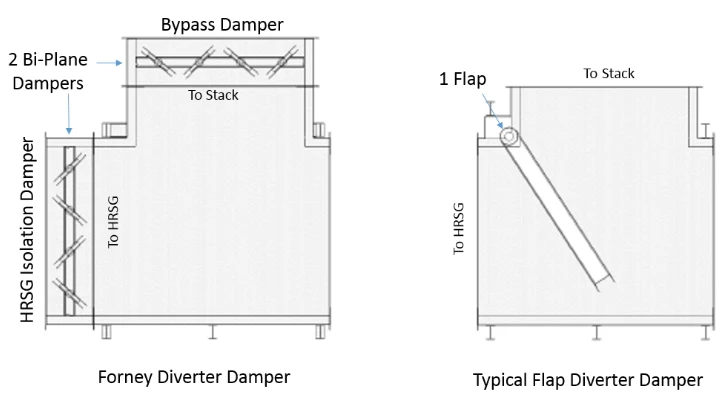
As shown above, Hangguo uses 2 dual-plane dampers instead of one large baffle damper. The split damper system controls the flow of turbine exhaust gas (TEG) between the bypass stack or HRSG. Hangguo's HRSG isolation damper allows exhaust gas to enter the HRSG when the bypass damper is closed, and forces the exhaust gas to rise to the bypass stack when the isolation damper is closed and the bypass damper is open. Hangguo's system also features a mechanical interlock that prevents both dampers from being closed at the same time, reducing the risk of inspection and maintenance hazards.
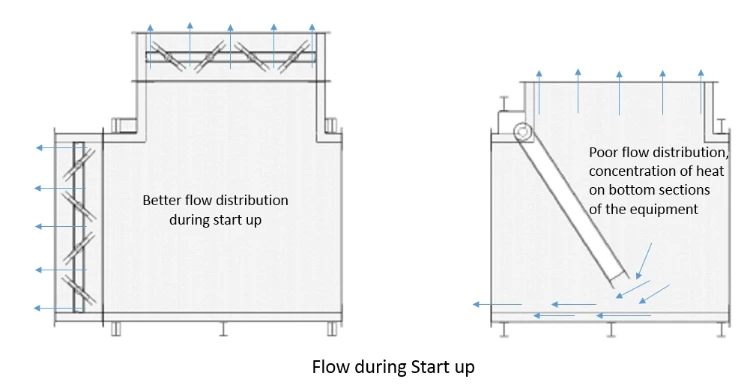
Hangguo's dual damper units are designed for peak or standby systems to meet peak power demands. It allows the HRSG to come online quickly and shuts off flow to the HRSG when peak demand is reached Common single-vane or baffle damper systems direct exhaust gases from the bottom of the intake duct to the HRSG at startup, creating a thermal gradient between the duct and the HRSG. However, the poor airflow created by the slightly open blades at startup can cause high temperature differences, which can cause stress in the structure and shorten equipment life. The shaft of the baffle damper is mounted on one end, making it difficult to maintain straight blades for proper sealing. Due to the lack of reliability of the baffle damper, a guillotine damper is set behind the baffle damper for safety. In addition, when the HRSG is operating, heat escapes into the stack, reducing overall efficiency.
Unlike single-vane baffle-type dampers, Hangguo's dual-plane damper configuration delivers exhaust gases more evenly to the stack and HRSG, greatly reducing the temperature gradient across the structure. Similarly, the dual multi-vane dampers allow for a "soft start", which is a gradual transfer of turbine exhaust gases from the bypass stack to the HRSG, significantly reducing the thermal shock of both. Less pressure means longer equipment life and lower maintenance costs. Because the dual-plane design incorporates an air seal, there is no need for a guillotine-style damper.
Hangguo's design has safety built into it in two ways.
The first system prevents the closure of both the HRSG inlet and bypass dampers simultaneously by mechanically linking the two dampers together. The design requires one damper to be 80% open, thus ensuring that the turbine exhaust is not completely blocked. A mechanical interlock between the HRSG inlet damper and the bypass damper keeps both dampers open, locking the open damper beyond 80o and the paired damper closed beyond 10o. This interlock ensures padlock protection for maintenance personnel in the event of an HRSG isolation.
The second safety method uses an air seal system that pressurizes the blade cavity to a level above the exhaust pressure, creating an air curtain that allows access to the HGSG inlet for inspection or maintenance. It is designed to keep temperatures below OSHA requirements (140 degrees Fahrenheit), which is necessary for areas classified as confined spaces.

The damper blades themselves are a truss design (or bridge structure) that creates a cavity for the air seal system. In this system, two 200% capacity fans help keep seal air in the damper when in the closed position. To reduce seal air requirements, our damper design uses flexible seal packs to provide a seal for the blade tip. These seals are used on the upstream and downstream edges of adjacent blades and are bolted to the blade edge.
The truss design also maximizes the rigidity of the shutter blades, allowing the damper to operate through the rapid temperature changes encountered in this application. The upstream side of the blades is also insulated, reducing heat losses from closing the damper.
Carbon packing with a purge collar is also used in this application to protect the carbon components from exposure to corrosion and temperatures above 753oF (400oC) oxidation temperatures. It is equipped with a close-coupled self-aligning flange-block bearing assembly with a high-temperature insert. While it allows the shaft to move in both rotation and axial motion, it does not require external lubrication, which would attract dust and abrasives. The shaft itself is made of 17-4PH "high-strength" stainless steel.
When evaluating a HRSG bypass damper system, keep in mind the basic requirements it should meet:
The damper must provide zero leakage when closing the bypass stack or HRSG under maximum gas flow conditions.
Maintenance personnel should be able to safely enter the HRSG when the gas turbine is operating at full load, the damper is isolating the HRSG, and the seal air system is properly ventilated.